Organizational Structure
A look at the makeup of Staff Senate and how it fits in with the rest of University Governance
How is Staff Senate structured?
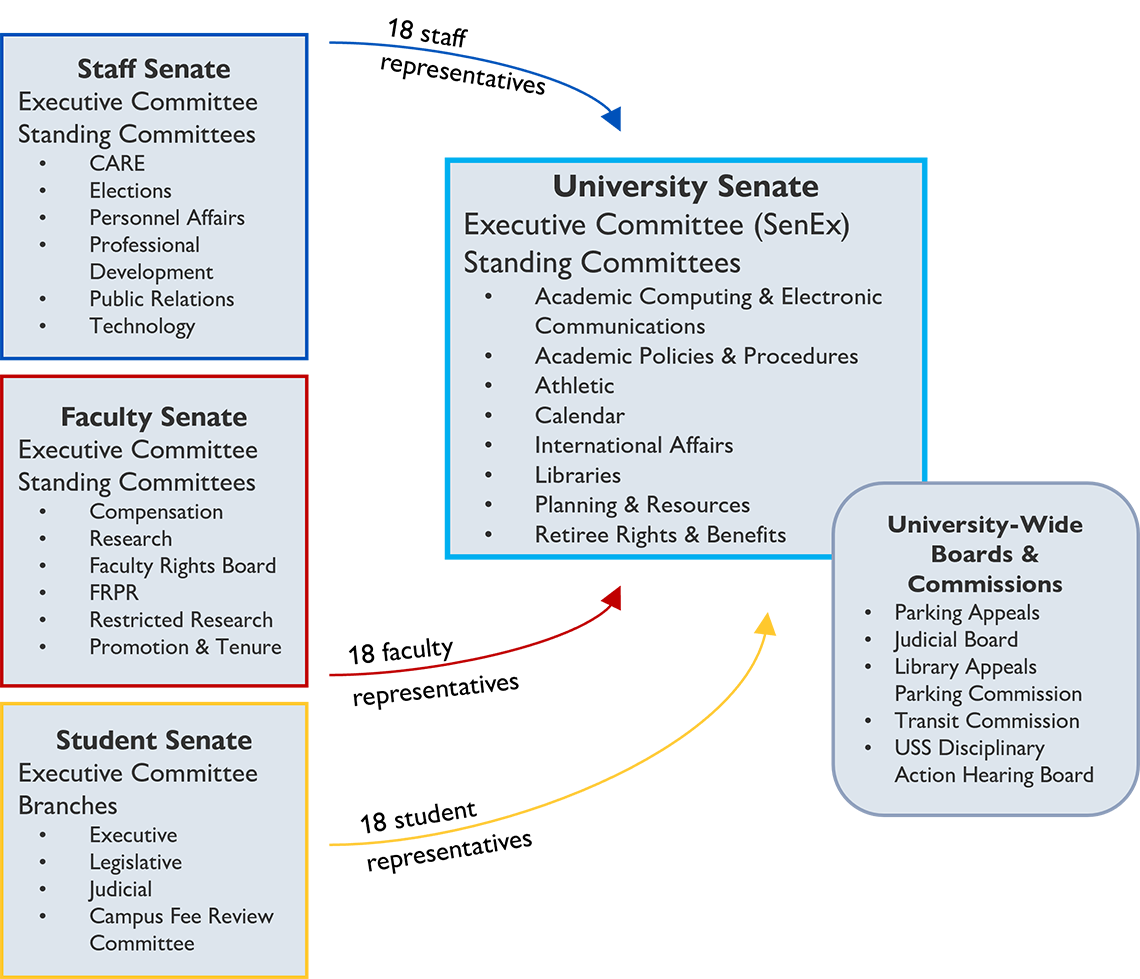
The Staff Senate is composed of staff representatives elected across the university and is organized into multiple leadership and advisory layers.
At the broadest level, senators are elected by job category, with one senator selected for every 75 staff members in each of eight categories: Academic, Administrative, Information Technology, Operations, Research, Student Services, Support, and Administration/Management.
From within the Staff Senate, an Executive Committee is formed to provide leadership and coordination. The Executive Committee includes the elected Officers—President and President-Elect, Secretary and Secretary-Elect, Treasurer and Treasurer-Elect, and Technology Officer—as well as standing committee chairs and chairs-elect.
The Executive Committee also includes representatives from Human Resources, the Faculty Senate, the Student Senate, and the Kansas Board of Regents University Professional and University Support Staff Shared Council (KBOR UPS-USS).
Where does Staff Senate fit into the bigger University Governance picture at KU?
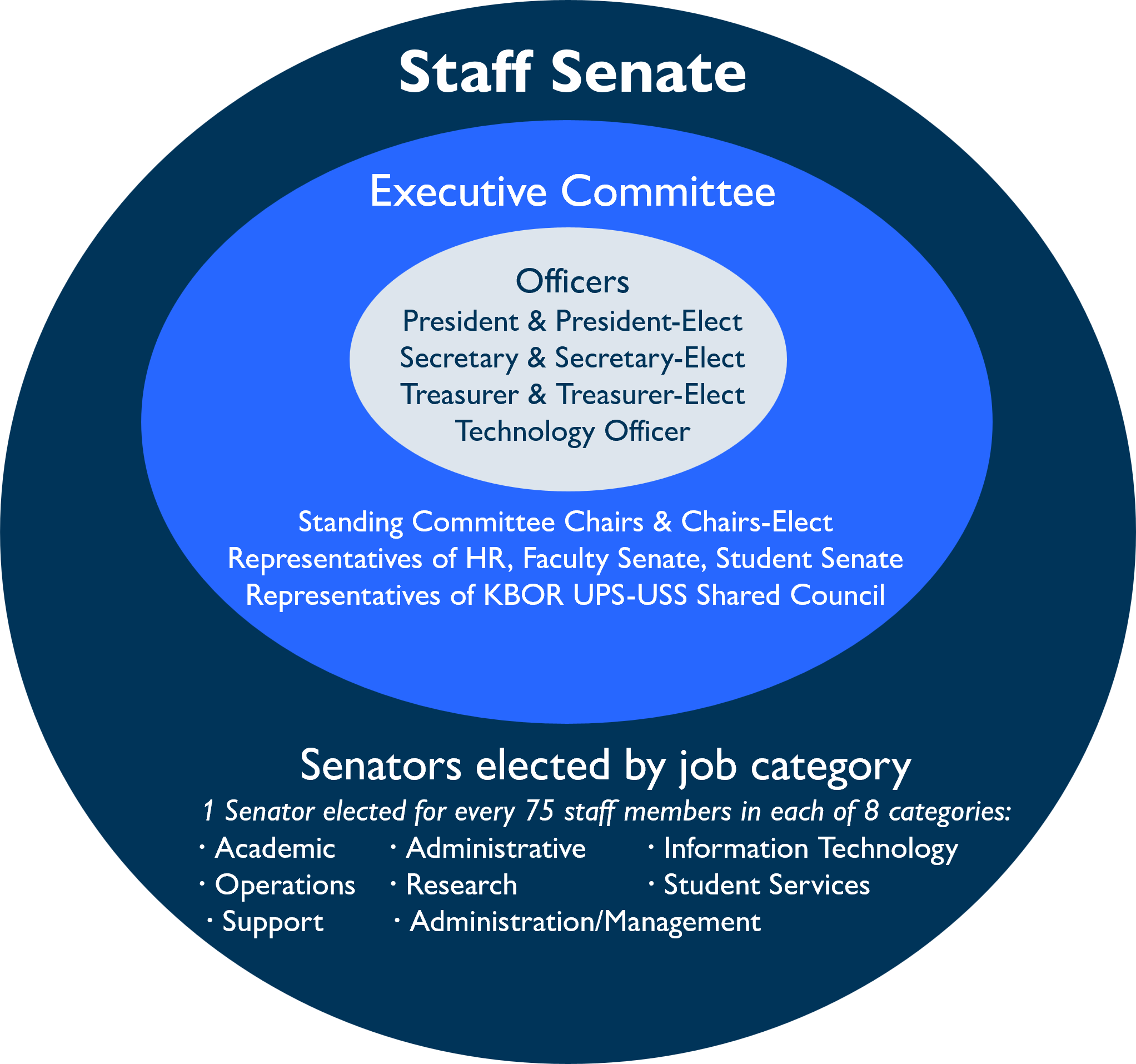
This graphic illustrates the university’s shared governance framework, showing how the Staff Senate, Faculty Senate, Student Senate, University Senate, and University-Wide Boards and Commissions are organized and relate to one another.
Each senate includes an Executive Committee and a set of standing committees or branches focused on specific areas of responsibility.
- Staff Senate includes committees such as CARE, Elections, Personnel Affairs, Professional Development, Public Relations, and Technology.
- Faculty Senate oversees committees related to compensation, research, faculty rights, promotion and tenure, and restricted research.
- Student Senate is organized into executive, legislative, and judicial branches and includes a Campus Fee Review Committee.
- University Senate, coordinated through the Senate Executive Committee (SenEx), includes standing committees covering academic policy, computing and communications, athletics, libraries, planning and resources, international affairs, and retiree rights and benefits.
- University-Wide Boards and Commissions provide oversight and appeals functions in areas such as parking, libraries, transit, judicial matters, and USS disciplinary action hearings.
Together, these groups represent faculty, staff, and students and support shared decision-making across the university.